
Cloudflare dropped a tool called isitagentready.com on April 17, 2026. Paste your URL, get a score out of 100 across 16 checks, see exactly what's missing.
We ran it on antitect.com the same week.
Let's just say there was room to improve.
The thing nobody's optimizing for yet
There's a new kind of visitor hitting your site. It doesn't read your nav. It doesn't hover on your CTA button. It hits your domain, looks for a handful of files at predictable URLs, and decides in milliseconds whether your site is worth its context window.
AI agents. Not chatbots. The autonomous kind that developers are using inside Cursor, Claude Code, and Windsurf to search documentation, compare services, and make recommendations on behalf of the actual human.
Cloudflare ran the numbers on this. They scanned the top 200,000 sites and found that only 4% declare any AI content preferences. Fewer than 15 sites globally expose an MCP Server Card or API Catalog. 78% have a robots.txt, but almost none of it is written for AI crawlers specifically.
So the web is basically invisible to agents. Which means the window where being agent-ready is a differentiator (rather than table stakes) is wide open right now.
What the score actually measures
The Agent Readiness score has 4 scored dimensions:
- Discoverability: Can agents find your site's structure without scraping it page by page? This covers robots.txt with AI bot rules, sitemaps, and HTTP Link headers that point agents directly to your API catalog and docs.
- Content: Do agents get clean data, or do they have to parse 2MB of React bundle? This checks for Markdown content negotiation and a properly structured
llms.txt. - Bot access control: Are you telling AI crawlers what they can and can't do? A properly configured robots.txt with explicit AI directives (not just Googlebot rules) matters here.
- Capabilities: Can an agent actually do something with your site? This is the MCP Server Card, API catalog, OAuth discovery, and agent skills index.
- There's also an agentic commerce section (x402, UCP, ACP) that checks for machine-to-machine payment support, though it doesn't affect the score yet.
What we actually fixed
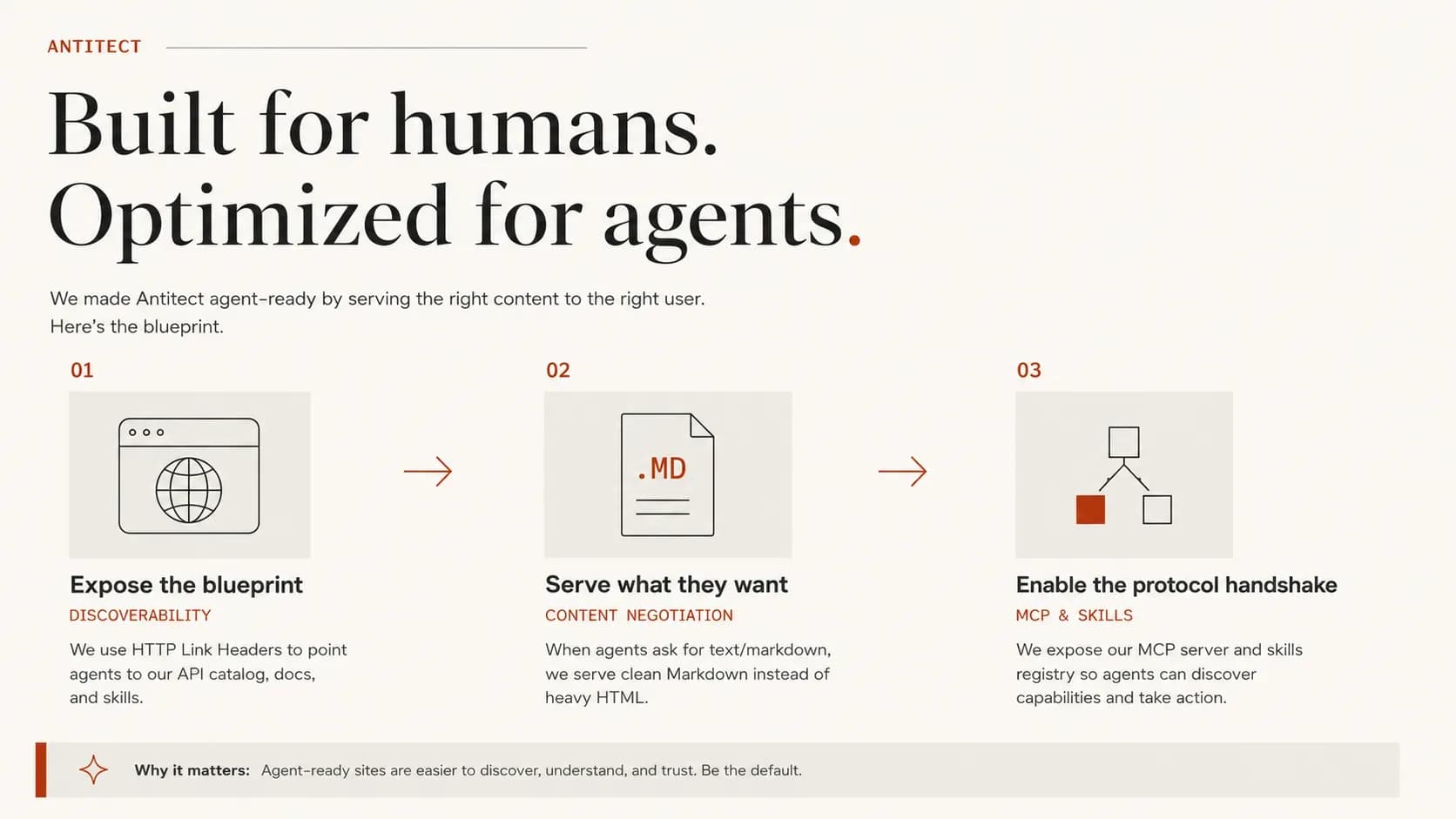
Link headers for discoverability
The lowest-effort, highest-signal fix.
When an agent hits our homepage, the HTTP response now includes headers pointing directly to our API routes, documentation, and skills registry. Three lines of config. Agents don't have to guess where things live anymore; we announce it in the handshake.
Markdown content negotiation
HTML is a visual format. To an LLM, parsing it to find the actual content is expensive: wasted tokens, slower responses.
Cloudflare measured this on their own developer docs and found that serving clean Markdown instead of HTML cut token consumption by 31% and made agent answers 66% faster. Same content. Different format.
We wired up content negotiation in our Next.js middleware. Standard browser requests get the full React render. Requests with Accept: text/markdown get routed to an API that pulls content from our Payload CMS and returns stripped Markdown with relevant metadata. The page size drops over 90%.
Only 3 agents request Markdown by default right now (Claude Code, OpenCode, Cursor). The rest need URL-based fallbacks like /index.md. We set up both.
llms.txt
Think of it like a sitemap, but written specifically for language models. A flat file at /llms.txt that tells agents what's on your site, what each section does, and where to go for what.
One thing worth knowing: a single massive llms.txt is actually a problem. If it exceeds an agent's context window, it triggers iterative keyword searches that are slower and less accurate. Cloudflare's own docs team solved this by publishing one llms.txt per top-level directory, with the root file pointing to subdirectories. We did the same.
MCP Server Card
This is the heavyweight. An MCP Server Card at /.well-known/mcp/server-card.json tells any MCP-compatible agent what tools your site exposes, how to connect, and how to authenticate, before it even opens a session.
We exposed ours with a description of the services we can interact with. Now an agent running inside a developer's IDE can discover us automatically, no custom integration required.
Build something that lasts.
Software, automation and websites for growing businesses.
Why this matters past the score
The Agent Readiness score is roughly what PageSpeed Insights was in 2012. Most people hadn't heard of Core Web Vitals yet. The ones who fixed their render-blocking scripts early got a free SEO advantage for years before it became table stakes.
This is the same gap. Fewer than 15 sites globally have MCP Server Cards. If you're in any kind of technical services space, and developers are your audience, their agents are going to be doing pre-purchase research soon (if they aren't already). The sites those agents can actually read and query get cited first.
Go scan your site at isitagentready.com. Pick the right preset for your site type (Content Site, All Checks, or API/Application). The default "All Checks" scan will under-score a pure content site for things it genuinely doesn't need, like OAuth discovery. So read the individual checks before you panic about the composite number.
Fix the easy stuff first: robots.txt AI rules, sitemap, Link headers. That alone probably moves you from Level 0 to Level 2.
Then worry about MCP.
We made antitect.com agent-ready in a few days. If you want the same done for your site, you know where to find us.